


 Cart
Cart
 sales@molnova.com


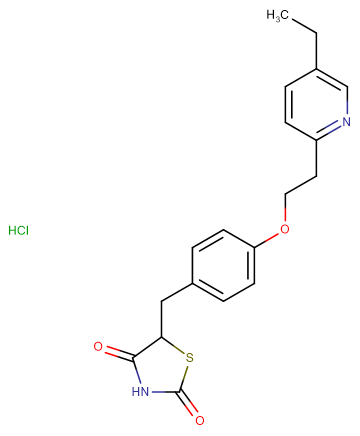
Pioglitazone hydrochloride
CAS No. 112529-15-4
Pioglitazone hydrochloride( —— )
Catalog No. M10440 CAS No. 112529-15-4
Pioglitazone hydrochloride can increase both insulin-stimulated glucose uptake in peripheral tissues and insulin sensitivity in hepatic and adipose tissue.
Purity : >98% (HPLC)
 COA
Datasheet
HNMR
HPLC
MSDS
Handing Instructions
COA
Datasheet
HNMR
HPLC
MSDS
Handing Instructions
| Size | Price / USD | Stock | Quantity |
| 50MG | 32 | In Stock |


|
| 100MG | 45 | In Stock |
|
| 200MG | 66 | In Stock |
|
| 500MG | 105 | In Stock |
|
| 1G | Get Quote | In Stock |
|
Biological Information
-
Product NamePioglitazone hydrochloride
-
NoteResearch use only, not for human use.
-
Brief DescriptionPioglitazone hydrochloride can increase both insulin-stimulated glucose uptake in peripheral tissues and insulin sensitivity in hepatic and adipose tissue.
-
DescriptionPioglitazone hydrochloride can increase both insulin-stimulated glucose uptake in peripheral tissues and insulin sensitivity in hepatic and adipose tissue. It is treated for hyperglycemia and Type 2 diabetes (T2D). Pioglitazone needs insulin as a co-factor for PPAR agonism so it is not effect when being treated to late stages of T2D with developed insulinopenia. In clinical trials, 15mg pioglitazone produces significant improvements in HbA1c and fasting plasma glucose (FPG).(In Vitro):AGEs-induced beta cell necrosis is completely abrogated by adding Pioglitazone to the AGEs culture medium. Furthermore Pioglitazone completely prevented any AGEs-induced increment in caspase-3 activation, thereby restoring caspase-3 activity to the same levels as the control cells. As expected AG is able to counteract AGEs-induced impaired viability. (In Vivo):The serum-free fatty acid and triglyceride levels as well as adipocyte sizes in ob/ob and adipo-/- ob/ob mice are unchanged after 10 mg/kg Pioglitazone but are significantly reduced to a similar degree after 30 mg/kg Pioglitazone. Moreover, the expressions of TNFα and resistin in adipose tissues of ob/ob and adipo-/- ob/ob mice are unchanged after 10 mg/kg Pioglitazone but are decreased after 30 mg/kg Pioglitazone. Thus, Pioglitazone-induced amelioration of insulin resistance and diabetes may occur adiponectin dependently in the liver and adiponectin independently in skeletal muscle. Pioglitazone (10 mg/kg per d) treatment significantly attenuates the loss of body weight (BW) and cardiac hypertrophy. Pioglitazone treatment significantly reduces the elevated serum glucose levels and markedly improved the associated dyslipidemia. Furthermore, there is a slight but significant increase in serum creatinine level in D rats over their N controls (P <0.05). However, a marked renal dysfunction is observed in diabetic nephropathic (DN) group (P<0.05). Moreover, DN rats exhibits the highest serum activity of CK-MB, relative to both N and D rats (P<0.05). Pioglitazone is able to decrease the elevated serum levels of both creatinine and creatine kinase-MB (CK-MB).
-
In VitroAGEs-induced beta cell necrosis is completely abrogated by adding Pioglitazone to the AGEs culture medium. Furthermore Pioglitazone completely prevented any AGEs-induced increment in caspase-3 activation, thereby restoring caspase-3 activity to the same levels as the control cells. As expected AG is able to counteract AGEs-induced impaired viability.
-
In VivoThe serum-free fatty acid and triglyceride levels as well as adipocyte sizes in ob/ob and adipo-/- ob/ob mice are unchanged after 10 mg/kg Pioglitazone but are significantly reduced to a similar degree after 30 mg/kg Pioglitazone. Moreover, the expressions of TNFα and resistin in adipose tissues of ob/ob and adipo-/- ob/ob mice are unchanged after 10 mg/kg Pioglitazone but are decreased after 30 mg/kg Pioglitazone. Thus, Pioglitazone-induced amelioration of insulin resistance and diabetes may occur adiponectin dependently in the liver and adiponectin independently in skeletal muscle. Pioglitazone (10 mg/kg per d) treatment significantly attenuates the loss of body weight (BW) and cardiac hypertrophy. Pioglitazone treatment significantly reduces the elevated serum glucose levels and markedly improved the associated dyslipidemia. Furthermore, there is a slight but significant increase in serum creatinine level in D rats over their N controls (P <0.05). However, a marked renal dysfunction is observed in diabetic nephropathic (DN) group (P<0.05). Moreover, DN rats exhibits the highest serum activity of CK-MB, relative to both N and D rats (P<0.05). Pioglitazone is able to decrease the elevated serum levels of both creatinine and creatine kinase-MB (CK-MB).
-
Synonyms——
-
PathwayMetabolic Enzyme/Protease
-
TargetPPAR
-
Recptorhuman PPARγ| mouse PPARγ
-
Research AreaMetabolic Disease
-
Indication——
Chemical Information
-
CAS Number112529-15-4
-
Formula Weight392.9
-
Molecular FormulaC19H20N2O3S·HCl
-
Purity>98% (HPLC)
-
SolubilityEthanol: 4 mg/mL (10.18 mM); DMSO: 79 mg/mL (201.06 mM)
-
SMILESCl.CCC1=CN=C(CCOC2=CC=C(CC3SC(=O)NC3=O)C=C2)C=C1
-
Chemical Name——
Shipping & Storage Information
-
Storage(-20℃)
-
ShippingWith Ice Pack
-
Stability≥ 2 years
Reference
1.Saad S, et al. Nephrol Dial Transplant. 2009 Apr; 24(4):1130-4
molnova catalog



related products
-
XAV939
XAV-939 selectively inhibits Wnt/β-catenin-mediated transcription through tankyrase1/2 inhibition with IC50 of 11 nM/4 nM in cell-free assays.
-
Muraglitazar
Muraglitazar (BMS-298585) is a PPAR α/γ dual agonist for the treatment of type 2 diabetes and associated dyslipidemia.
-
DG172 (dihydrochlori...
DG172 (dihydrochloride) is an ?antagonist of ?PPARβ/δ(IC50 : 27 nM).
